
Walls and soil support
Residential grading and commercial earth retention, using mass and interlock instead of mortar.
- Slope stabilization
- Site elevation control
- Permanent and semi-permanent walls
Precast · Dry-stacked · Shipped nationwide
Interlocking concrete blocks turn a pile of units into one connected wall. They carry load the moment they are set, with no mortar and no curing, and we supply them to contractors across the U.S.
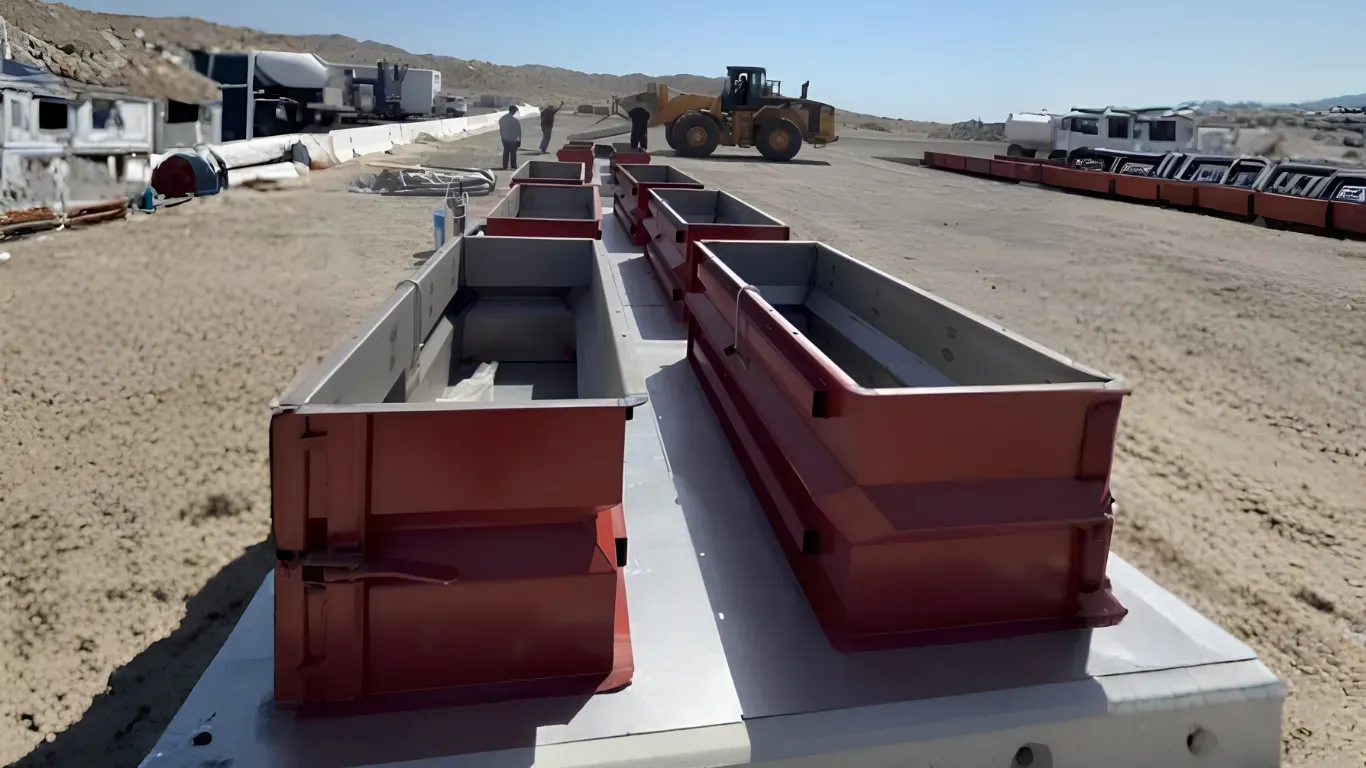
Each interlocking block keys into its neighbors and becomes part of one heavy structure. Weight and shape keep the wall from moving, not mortar joints that weaken with age.
That makes these blocks a good fit wherever traditional masonry slows a job down: walls that hold back soil, industrial containment, commercial grading and large infrastructure. They go from the truck to the wall with no setup time.
Use this table to plan freight and crane or excavator lifts. Blocks are cast in a controlled setting with graded aggregate to cut down the air pockets that lead to cracks.
| Block type | Size (L x W x H) | Approx. weight | Used for |
|---|---|---|---|
| Full block | 5 x 2.5 x 2.5 ft | 4,800 lb | Main wall runs, bulk storage bays |
| Half block | 2.5 x 2.5 x 2.5 ft | 2,400 lb | Wall ends and stepped transitions |
| Low-profile | 5 x 2.5 x 1.25 ft | 2,400 lb | Caps and fine height adjustments |
Build the main run with full blocks. Use half blocks to finish wall ends and to step a wall down a slope without cutting. Top the wall with low-profile units when you need a cap or a final height between full courses.
These blocks work as modular structural units, so one product covers several kinds of work.
Residential grading and commercial earth retention, using mass and interlock instead of mortar.
Containment that stands up to impact, moving equipment and changing site layouts.
Bulk material control and containment on farms and utility yards.
On large builds, interlocking concrete blocks remove the steps that slow conventional walls down.
Blocks are dry-stacked, so there is nothing to mix and nothing to wait on. The wall carries load right away.
A modular system needs fewer specialist masonry skills on site.
Each unit locks into the next, forming one mass that resists sideways movement without joints to fail over time.
Unlike a mortared wall, an interlocking wall can be taken apart and rebuilt somewhere else.
Savings come from shorter labor time, faster installs, less idle equipment and simpler staging.
The blocks keep their structure through temperature swings, heavy rain and years of exposure.
Industrial yards, infrastructure projects and commercial facilities use interlocking block walls where a failure would stop work. The strength comes from the whole system, not only the weight of each block.
Each layer keys into the one below, so the wall behaves as one structure and resists shifting from load, vibration and ground pressure.
Loader strikes and equipment moving past the wall are part of daily work on an industrial site. Heavy, interlocked units take those hits without walking out of line.
The system follows precast concrete practice used across U.S. construction.
01
At 2,400 to 4,800 lb per unit, weight is what keeps a gravity wall standing.
02
Mixes are designed for about 2,500 to 4,000 PSI, matched to the application.
03
Crushed stone controls density and reduces voids for long service under load.
04
Tongue-and-groove or lug connections keep blocks aligned and limit sideways shift.
05
Force spreads across many contact points instead of resting on mortar joints.
06
Blocks follow standard U.S. precast testing practice for consistent results.
Ordering follows how construction works: by project, not by shopping cart. We deliver to job sites, staging yards or storage locations anywhere in the U.S.
Loads ship on flatbed or step-deck trucks, depending on size and site access. Lead times depend on order volume, the production schedule and distance, and we give you dates up front so you can line up crews.
Structural walls, walls that hold back soil, barriers and containment, all built without mortar. They are a fast way to build at scale.
In many structural uses, yes. The interlock spreads load across the whole wall, which makes it more stable than a mortared wall of the same mass.
Yes. Their mass and interlock handle sideways soil pressure well. Have an engineer design any tall or loaded wall.
No. They are dry-stacked and lock mechanically, so there is no mortar and no curing time.
Yes. We supply bulk orders across the United States with delivery planned around your project.
Send your wall length or footprint, the block type and the delivery address. We will reply with a price and a delivery date.