
Gravity walls
Build a wall that holds soil by weight alone, with no poured concrete or cure time.
- No footing needed in most cases
- Set with standard equipment
- Easy to extend or rearrange
Bulk orders · Shipped nationwide
Concrete barrier blocks for site perimeters, material bins and gravity walls. Three standard sizes, an interlock that keeps rows straight, and truckload delivery anywhere in the U.S.
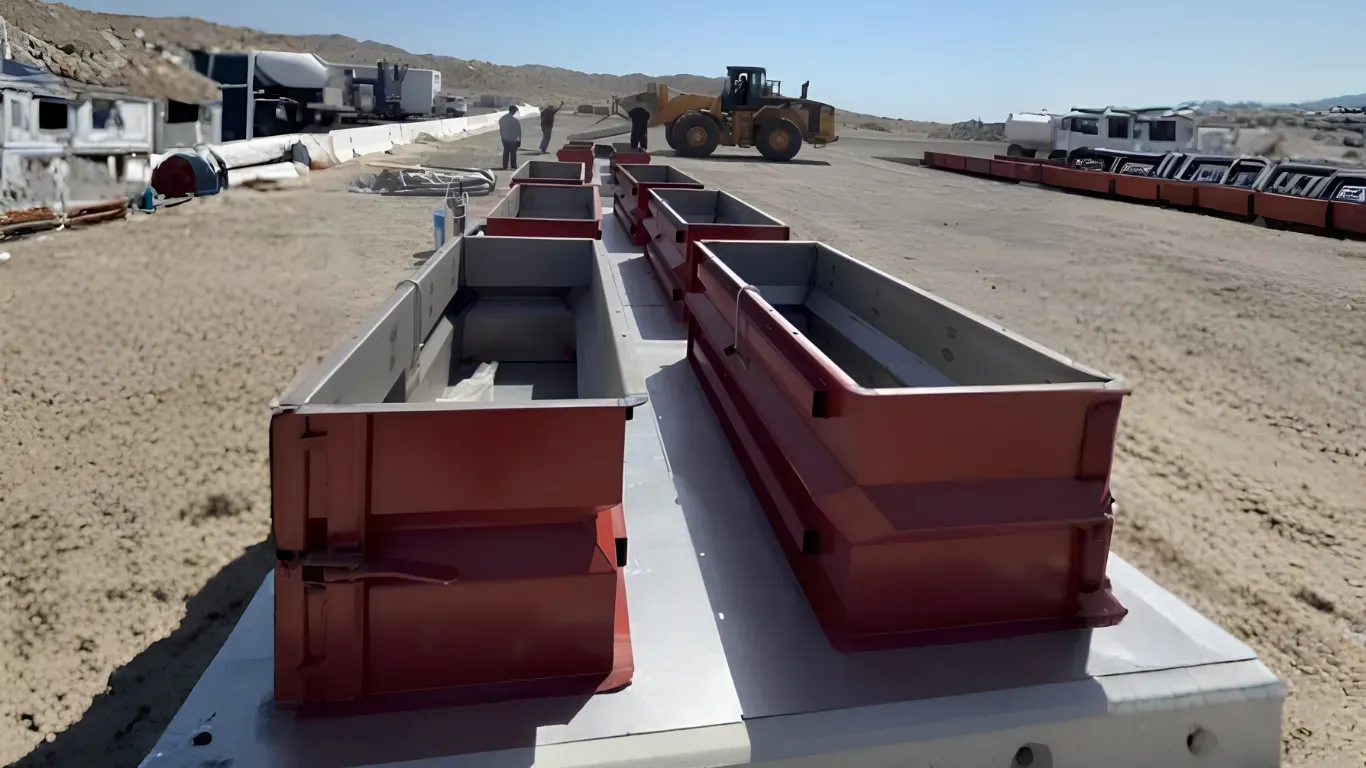
Detachment 5 Block supplies concrete barrier blocks and bin blocks by the truckload to contractors, yard managers and bulk buyers across the country. They are made for places that take a beating: storage yards, active job sites and farm operations.
Each unit handles heavy loads and repeated use. The interlock keeps every course in line as you stack, so crews can work fast without the wall shifting. There is no curing time and no complicated install. Set the block, stack the next one, move on.
Three standard sizes cover most walls, bins and barriers. Plan around these, and we confirm exact weights on your quote.
| Block size (L x W x H) | Approx. weight | Typical use |
|---|---|---|
| 6′ x 2′ x 2′ | about 3,500–4,000 lb | Main wall runs and large barriers |
| 4′ x 2′ x 2′ | about 2,000–2,800 lb | Mid-size walls and bin structures |
| 2′ x 2′ x 2′ | 1,000–1,500 lb | Corners, top courses and adjustments |
Blocks lock together with a tongue-and-groove or V-shaped key. That connection does three jobs:
The same block solves different problems across construction, recycling and farming.
Build a wall that holds soil by weight alone, with no poured concrete or cure time.
Separate and store bulk material. Weight and interlock stand up to high side pressure and loader impact.
Mark off space and protect people and equipment. Leave them in place or move them when the job changes.
You are building a modular system, not a pile. Here is how it works on site.
Lower a block onto the course below and it drops into position. The key stops it from sliding, so rows stay in line without constant adjustment. No mortar, no anchors.
Get the first course level and the rest follow. The interlock guides each block into place, which means less measuring and less correcting over long runs.
Every unit weighs one to two tons, so mass does much of the work. Gravity holds the structure together, and the interlock keeps it from moving.
This is where most projects lose time, so here is what to expect before the truck arrives.
| Block size | Blocks per load (typical) |
|---|---|
| 6-foot | about 8–12 |
| 4-foot | about 12–18 |
| 2-foot | about 18–30 |
A standard flatbed carries 40,000–48,000 lb. Heavier blocks mean fewer per truck. Final counts depend on block size, weight limits and distance, and we plan the loads with you.
If access is tight, call us and we will help plan the drop. Large jobs can get scheduled, staged deliveries.
Anyone can drop off blocks. The difference shows up once you start stacking.
We plan production around your total order, so you do not run short halfway through a build.
Each unit is cast to the same spec, so tall walls and long runs stack clean with no forcing.
We plan around your access points, equipment and timing, including boom truck drops and staged loads.
Gravity walls, loader-struck bins and perimeter barriers all depend on mass from day one.
Send three things: how many blocks or truckloads you need, the block size if you know it, and the delivery address. If you are unsure about size, we will work it out with you.
You get a price built for your project plus clear delivery details: when the trucks arrive, how many loads, and what equipment to have ready. No waiting days for a number.
Precast concrete units that interlock without mortar. They are used to build gravity walls, material bins and site barriers.
Our standard sizes run from 1,000–1,500 lb for a 2-foot block to about 3,500–4,000 lb for a 6-foot block. Exact weight depends on the mix.
Yes. Their weight and interlock let them hold soil as gravity walls, usually without extra reinforcement. Have an engineer review taller or loaded walls.
Usually not. A compacted, level base of crushed stone or prepared aggregate is typically enough.
By flatbed or similar truck. Unload with a forklift, telehandler or crane; each block has lifting points for safe handling.
Yes. They can be taken apart, moved and restacked many times without losing strength.
Tell us the quantity, block size and delivery address. We will reply with a price and a truckload plan.